
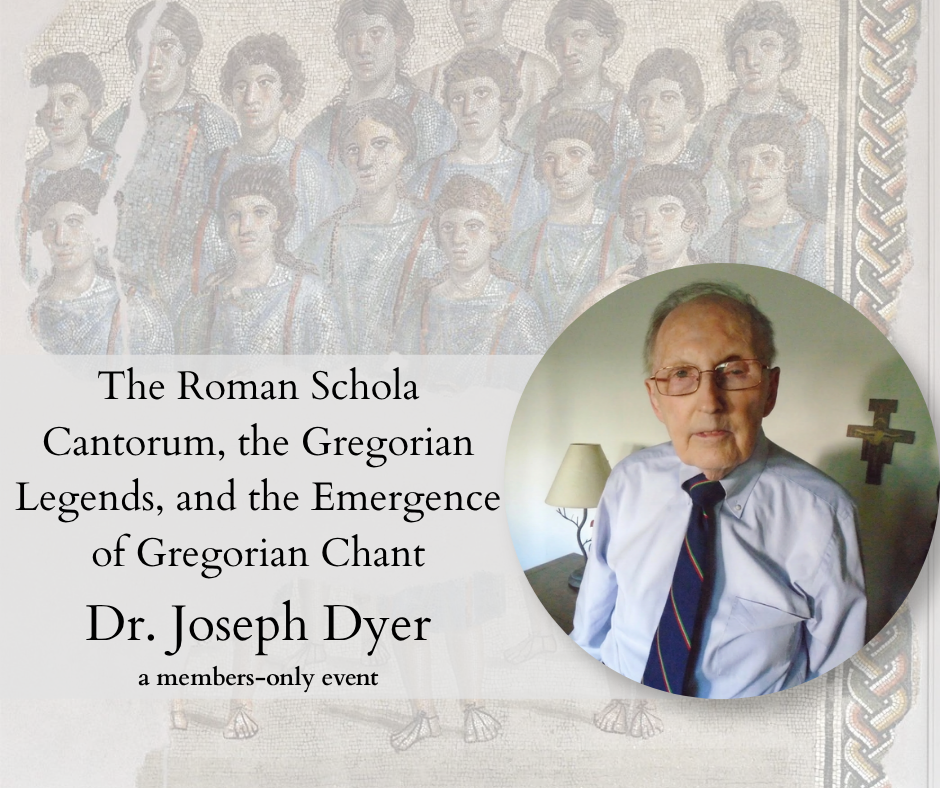
The Roman Schola Cantorum, the Gregorian Legends, and the Emergence of Gregorian Chant
All event times are in Eastern Time.
Join Dr. Joseph Dyer for a presentation on the Roman Schola Cantorum, the Gregorian Legends, and the Emergence of Gregorian Chant!
In this one-hour session Dr. Joseph Dyer will present on the Roman Schola Cantorum, the Gregorian Legends, and the emergence of Gregorian Chant.
Summary: The choir of singers who supplied music for the solemn liturgies of the bishop of Rome stand at the head of the entire development of western music. Their services must have been required as soon as Constantine permitted Christian worship in public. What little can be known of them must be extracted from references in papal biographies and ordines that describe ceremonial. The papal singers were later promoted to the status of a schola of the Lateran administration. Over time, as chant genres (introit, etc.) were added to the Mass, the Roman singers created a corpus of music for them. When Pippin (d.768), king of the Franks, and his successors became interested in planting Roman music on Frankish soil, the schola cantorum devised a plan to “trademark” their repertoire by assigning to Pope Gregory the Great (d. 603) a prominent role, thus leading to the identification of their repertoire as “Gregorian.” What is now identified by that name is thought to have been created by Frankish cantors in the late eighth and early ninth centuries. How this happened is one of the great mysteries of music history.
If you have any questions on this topic which you would like addressed during the presentation, please send them to gm@musicasacra.com.
This event is open to CMAA members only.
Not a member? Join today! https://churchmusicassociation.org/about-cmaa/membership/
About Dr. Joseph Dyer: Dr. Dyer taught music history at the University of Massachusetts Boston. He has published numerous articles, book chapters, and encyclopedia entries on music and liturgy, psalmody, medieval music theory, the liturgy of Rome, and music in the intellectual life of the Middle Ages. Two recent publications are: “A solis ortu usque ad occasum: The Bible in the Medieval Mass and Office,” in La Bibbia dal Tardo Antico all’Alto Medioevo, Settimane di Studio dell’Centro Italiano di Studi sull’Alto Medioevo LXXII, Spoleto, 24-30 aprile 2025 (Spoleto, 2026), pp. 375-432; and “Laity and Clergy in Collective Spaces, Places, and Rituals of Early Medieval Rome,” in A Companion to Rome (c. 400-c. 1050), 2 vols., ed. Caroline Goodson and Julia Hillner (Leiden, 2026), 2:564-92. He is a Fellow of the Royal School of Church Music.