
IN MEMORIAM
Rev. Robert A. Skeris
1935–2025
One of the great pioneers of the Church Music Association of America has passed to his eternal reward. Rev. Robert A. Skeris died peacefully on February 18, 2025, in his hometown of Sheboygan, Wisconsin. Please pray for the repose of the soul of this great priest.
Intellectually and musically gifted, Father Skeris began his priestly life just before Vatican Council II (1962–65). Following the Council, he found himself an unwitting player in the unfolding drama of ground-shifting changes in the Catholic Church. Monsignor was a valiant and brilliant soldier in the Church Militant, wielding the sword of his intellect and wit, no less than the sword of the Spirit.
Born May 11, 1935, in Sheboygan, Wisconsin, to Lithuanian-American parents, the young Robert Skeris attended local Catholic schools; he earned his bachelor’s degree at Saint Francis de Sales Seminary (St. Francis, Wisconsin). He was ordained to the priesthood on May 27, 1961, at the Cathedral of St. John the Evangelist, Milwaukee.
Fr. Skeris began his priestly ministry as assistant pastor at St. Joseph Parish, Racine, 1961–1963. Next followed a stint as a professor at Saint Francis de Sales Seminary, St. Francis, from 1964–1971, during which time he witnessed a post-Vatican II revolt of the seminarians. Father Skeris continued his academic studies by earning an M.A. in Liturgical Studies from the University of Notre Dame, and after studies in Cologne and Bonn, he received his doctorate in Theology in 1975 at the Rhenish Friedrich-Wilhelms Universität in Bonn. In the early 1970s Father Skeris was an Associate Professor of Theology at the University of Dallas, where he taught Sacramental Theology, Liturgy, Ecclesiology, and Apologetics, as well as Church Music, at Holy Trinity Seminary, on the campus of the University of Dallas. After Dallas, Father Skeris conducted research in Hymnology at the University of Southern California and the Claremont Colleges.
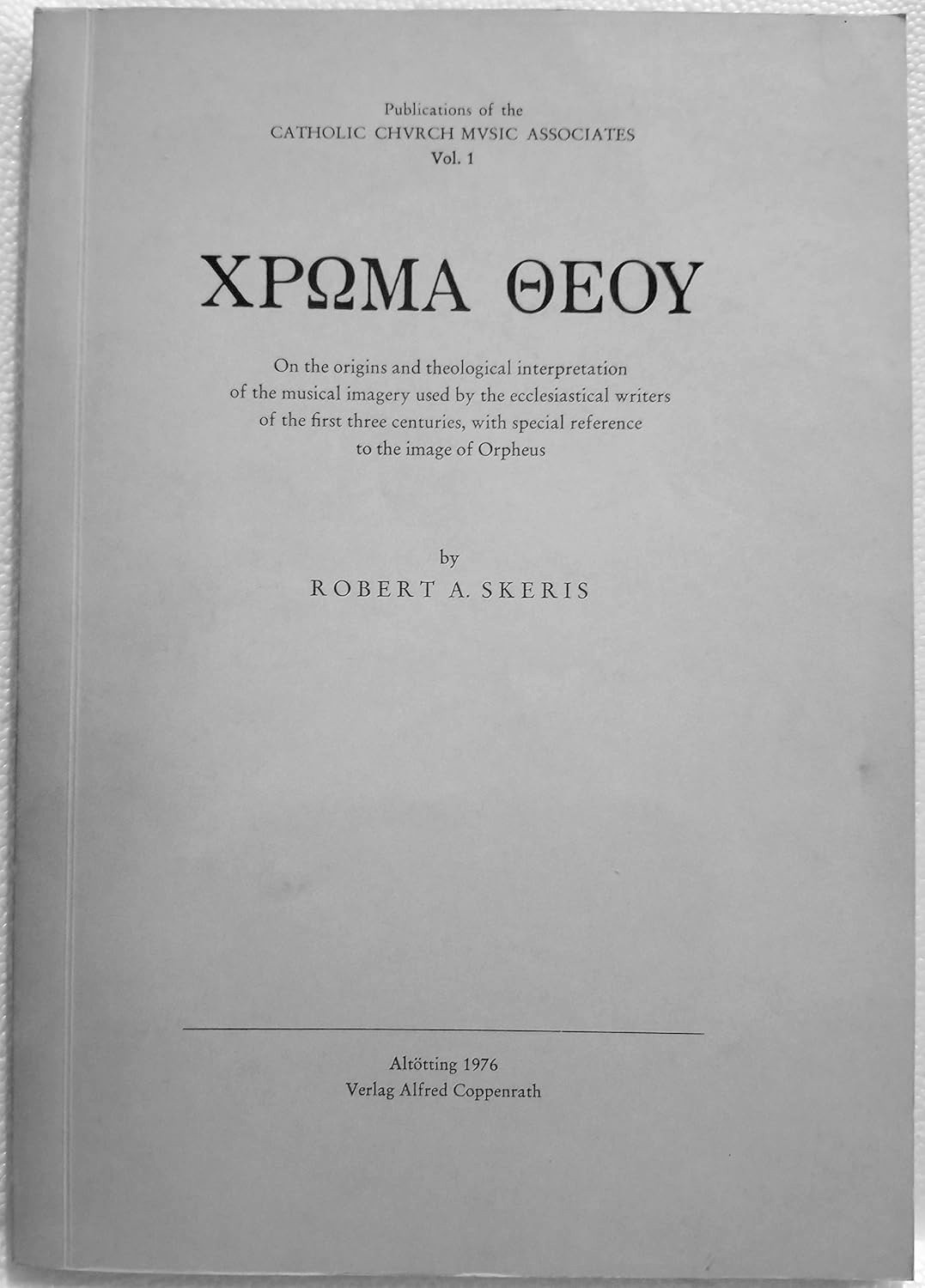
As a scholar, Father Skeris was eager to develop a theory of music and worship. In 1976 he published ΧΡΩΜΑ ΘΕΟΥ1 (Chroma Theou), the first volume in a series—Musicæ Sacræ Melethmata—of Publications of the Catholic Church Music Associates. This series had been planned by CMAA’s Board of Directors in 1972. In the Foreword to the book (which was his doctoral dissertation) Father Skeris self-effacingly referred to his dissertation when he wrote: “As a result of detailed scientific studies at the University of Bonn/West Germany, there appears herewith the first volume of the series.” He continued with a statement containing the kernel of all his future work in the theology of sacred music.
The volume presents a musico-theological investigation of musical imagery in the ecclesiastical writers from the sub-apostolic period until the age of Constantine. The results are of such fundamental significance for the theological meaning and position of musica sacra that publication as the first of a series of further contributions was decided upon.
In the book, Father Skeris looked back to early sources of Palestine and Syria, and especially of the patristic writers for his integrated vision of sacred music and its important place in the sacred liturgy and in the economy of salvation. This would be his theme throughout the rest of his life, whether speaking of it in formal academic lectures or in parish workshops on Gregorian chant.
Other volumes in the series included Crux et Cithara2 (1983), a Festschrift in honor of Monsignor Johannes Overath for his seventieth birthday (among the contributors was Joseph Cardinal Ratzinger), and Divini Cultus Studium3 (1990), another volume of essays, this time mostly by Father Skeris, but including one each contribution from Pope John Paul II and Cardinal Ratzinger. Volume Five was a monograph, The Bugnini-Liturgy and the Reform of the Reform4(2003), by the esteemed Hungarian musicologist László Dobszay.
The years 1978–1986 saw Father Skeris in Germany as Director of the Hymnology Section at the Institute for Hymnological and Ethnomusicological Studies, Maria Laach. One of the fruits of this period was Das deutsche Kirchenlied: Kritische Gesamtausgabe der Melodien (Bärenreiter, 1993), of which he was a co-author.5 From Germany he went to Rome, where he was a professor, specifically Prefetto della casa, at the Pontifical Institute of Sacred Music from 1986–1990.
In 1990 Father Skeris returned from Europe to the United States, this time moving to Christendom College, in Front Royal, Virginia. There he served as an Associate Chaplain, Chairman of the Theology department, and Director of the college’s choir and Schola Gregoriana until his retirement in 1999. At Christendom Father Skeris had a lasting impression on several generations of students. One priestly alumnus, Father Christopher Smith, has expressed it well:
When I was in high school, a lady at my church gave me some copies of a magazine called Sacred Music. I was so struck by some articles on liturgy and music written by Father Robert Skeris that I based my decision to go to Christendom College for my undergraduate education in part to study under him. As an expert at Vatican II and once rector of the Pontifical Institute for Sacred Music in Rome, he remains the most gifted teacher I have ever had in my life. Father Skeris was a demanding man: we spent hours a week in chant scholas and choirs where he gave a bunch of college kids in Front Royal the tools to perform and teach Gregorian chant and sacred polyphony. But he also was a profound theologian, and we were raised to a very high bar where we were expected to be precise, real, and accurate. He was the kind of teacher that you wanted to please, and at whose feet you knew you could gain so much. … Fr. Skeris taught us that the Church’s patrimony of sacred music and a liturgy animated, not by experimentation but by a rich theology of Christian life and worship, was the true expression of our Ordinary Form of the Mass after Vatican II. … From Fr. Skeris I learned to appreciate the theology that is behind the Mass, and why the correct and beautiful execution of sacred rites and ceremonies is so important. It is not an exercise in antiquarianism, but a living tradition by which the faith is communicated whole and entire.6
The new millennium saw Father Skeris serving as chaplain to the Latin Tridentine Community in the Milwaukee Archdiocese from 2000 to 2007, until that apostolate at Saint Stanislaus Oratory was assumed by the Institute of Christ the King. Concurrently, Father Skeris held positions at the Benjamin T. Rome School of Music, The Catholic University of America (CUA), Washington, D.C. as Adjunct Professor, Chairman of the Dom Mocquereau Foundation, and Director of the Centre for Ward Method Studies.
Father Skeris was central to the founding of the Church Music Association of America (CMAA) in 1964. He was one of several leaders—along with Father Richard Schuler, Monsignor Francis Schmitt, and Father John Selner—among the sixty-three or so American church musicians present at Boys Town, Nebraska, for the twelfth annual liturgical music workshop. This workshop could be considered the predecessor to, and the inspiration for, the CMAA Sacred Music Colloquium, started by Father Skeris in 1991. CMAA was to be the American affiliate of the Consociatio Internationalis Musicæ Sacræ (CIMS), which Pope Paul VI had founded on November 22, 1963, the feast of Saint Cecilia. In his chirograph Nobile subsidium liturgiæ, the Holy Father had set up the CIMS as an “international institute which would be able to make known [to the Holy See] the needs of sacred music, and which would be able to assist in putting the decisions of the supreme ecclesiastical authority relating to sacred music into practice.”
The CMAA was a merger of two already existing church music organizations with distinguished histories, the American Society of Saint Cecilia (established in 1874) and the Society of Saint Gregory of America (established in 1913). At the Boys Town meeting, after a constitution was drafted and officers were selected for one year, Father Skeris—along with Fathers Richard Schuler and Francis Brunner—proposed two resolutions which to this day have remained the mission of the CMAA.
1) We pledge ourselves to maintain the highest artistic standards in church music;
2) We pledge ourselves to preserve the treasury of sacred music, especially Gregorian chant, at the same time encouraging composers to write artistically fine music, especially for more active participation of the people according to the norms of the Constitution on the Sacred Liturgy of the Second Vatican Council and the wishes of the American hierarchy.
From 1968 to 1974, Father Skeris served the CMAA as Secretary and as Vice President, and in 1974 he was elected President for the first time; his later term as president lasted from 1998–2005.
When Father Skeris started the CMAA Sacred Music Colloquium in 1991, it was held at Christendom College, where Father Skeris had just finished his first year. In 2003 the Colloquium moved to CUA, and from 2008 on, it has been held in a variety of locations. Like the Christendom College students, attendees at the Colloquium were both awed and delighted by Father Skeris. After his many lectures on the theology of worship and music all over the world, Colloquium attendees were privileged to learn and assimilate these lofty ideas from Father Skeris himself. Attendees got to sing from editions of great sacred music edited by Don Capisco, Father’s alter ego, and they delighted in Father Skeris’ abundant wit through, for example, his frequent use of three alliterative titles: the legitimate liturgist, the thoughtful theologian, and the competent Kapellmeister. One even finds these expressions in his writing, along with other instances of his wit. Father Skeris modestly styled himself all three of these, but he was far more—a brilliant, holy priest whose life was dedicated to the praise and glory of God and to the One, Holy, Catholic, and Apostolic Church.
–Susan Treacy
A video recording of Fr. Skeris’ funeral at St. Cyril and Methodius Church in Sheboygan is on-line.
Notes:
- Robert A. Skeris, ΧΡΩΜΑ ΘΕΟΥ: On the Origins and Theological Interpretation of the Musical Imagery used by the Ecclesiastical Writers of the First Three Centuries, with Special Reference to the Image of Orpheus (Altötting, 1976).
- Crux et Cithara: Selected Essays on Liturgy and Sacred Music Translated and Edited on the Occasion of the Seventieth Birthday of Johannes Overath, ed. Robert A. Skeris (Altötting, 1983).
- Divini Cultus Studium: Studies in the Theology of Worship and of Its Music, ed. Robert A. Skeris (Altötting, 1990).
- László Dobszay, The Bugnini-Liturgy and the Reform of the Reform (Front Royal, Va., 2003).
- The German Church Song (i.e., hymn): Critical Collected Edition of Melodies (Bärenreiter, 1993).
- Fr. Christopher Smith (Class of 1999) is pastor of Prince of Peace Catholic Church, Taylors, South Carolina. This quotation comes from a Facebook post of May 23, 2017.
Photos:
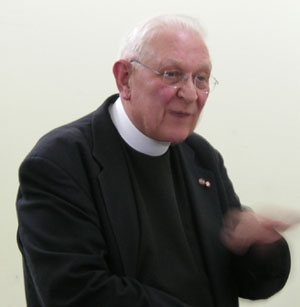
- At the 2006 Sacred Music Colloquium, photo by Fr. Jeffrey Keyes
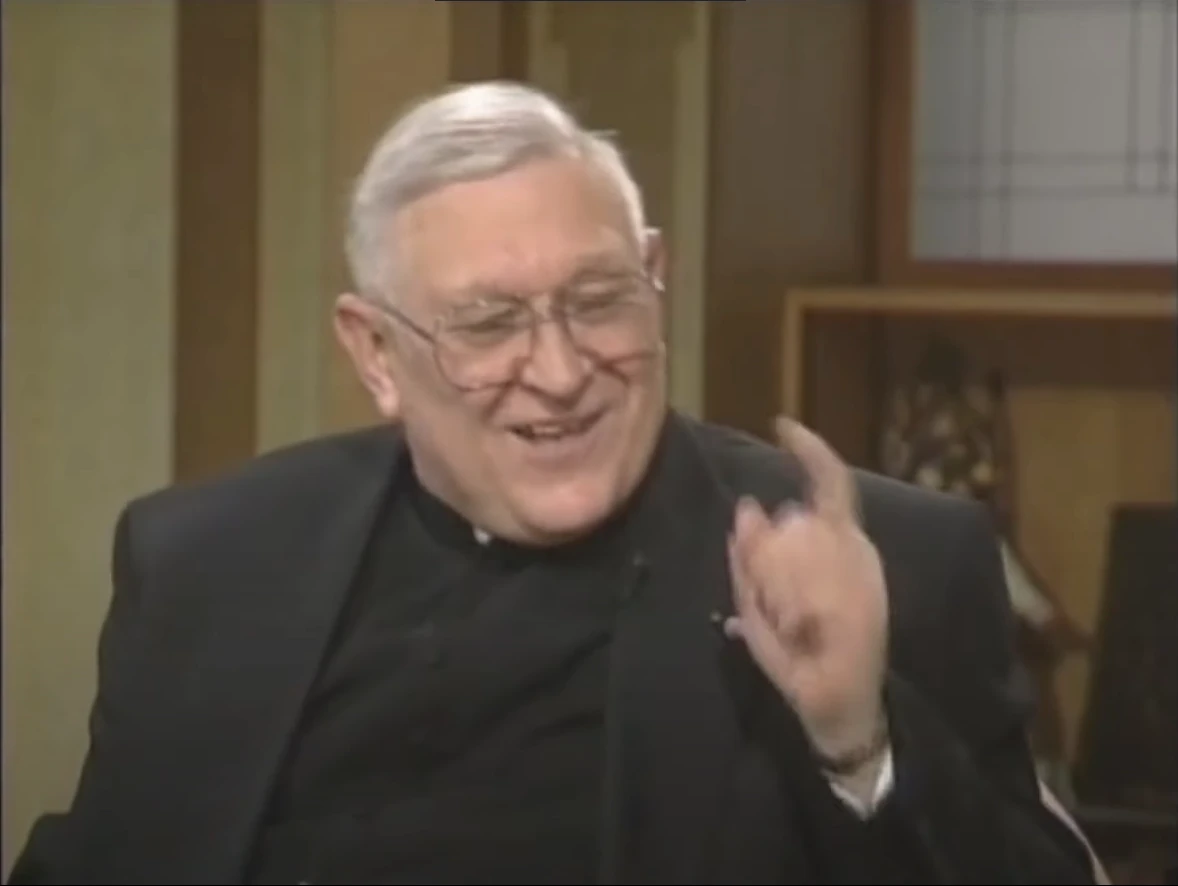
- On EWTN in 1998, talking about the theology of worship with Mother Angelica
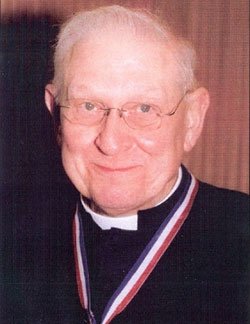
- Fr. Skeris, honored as a Knight Commander of the Equestrian Order of the Holy Sepulchre
- A copy of Chroma Theou once owned by Paul Salamunovich; photographer unknown
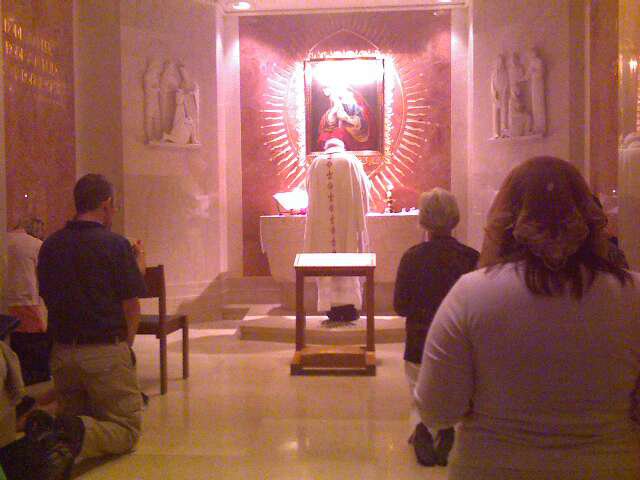
- A Mass in the National Shrine of the Immaculate Conception, during the 2010 Ward Method summer courses; photo by Richard Chonak