Teaching Resources
“We have to start building the Church through God’s children, that all may sing.”
Justine Bayard Ward


CMAA Teaching Texts
Learning Starts Here
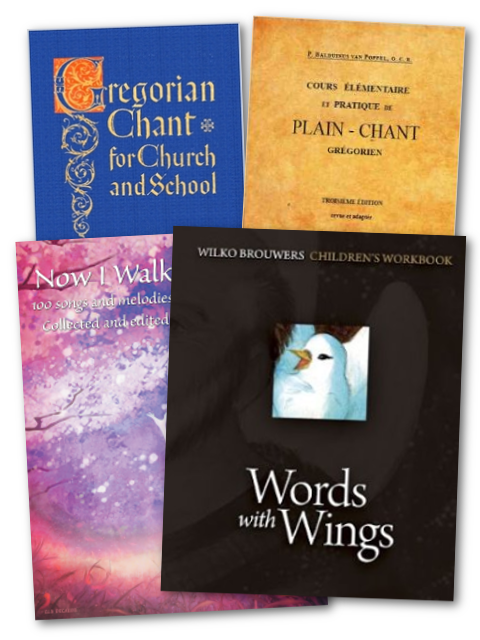
The CMAA offers ample opportunity for improving your parish and school music. Purchase high quality teaching tools in one of many available areas:
-
- Vocal Production
- Conducting / Chironomy
- Gregorian Chant
Teaching Children
Children’s Chant for the Third Millennium (booklet and audio files)
Gregorian Chant Vol. II (Justine Ward, 1949)
Story of Redemption in Chant (children)
General Teaching Materials
Dominic Johner, OSB: A New School of Gregorian Chant (1925)
Arlene Oost-Zinner and Jeffrey Tucker: An Idiot’s Guide to Square Notes
Robert Joseph Carroll: An Applied Course in Gregorian Chant (1956)
Sr. Mary Demetria: Basic Gregorian Chant and Sight Reading (1960)
Common Tones for the Sung Mass (excerpt from the Liber Usualis)
Balduinus Van Poppel, OCR: Cours Élémentaire et Pratique du Plain-Chant Grégorien (solfège exercises)
Guide to Neumes, from Marier and Turkington’s “A Gregorian Chant Master Class”
Joseph Robert Carroll: Technique of Gregorian Chironomy (1955)
Gregory Suñol, OSB: Textbook of Gregorian Chant (1930)
The Ward Method
The Ward Method of Music Instruction is a progressive method of teaching elementary school children – through vocal instruction – music theory, composition and conducting. The Method was developed to teach American Catholic school children the fundamentals of music so that they would be able to sing the vast repertoire of sacred music which is a part of the Roman Catholic Church’s tradition. The Ward Method is unique in that it has a basis in Gregorian chant.
Amy Zuberbueler, Director of The International Center for Ward Method Studies, CUA
Justine Bayard Ward (1879-1975)
Mrs. Ward, the founder of the method bearing her name, was born on August 7, 1879. In 1904 she converted to Catholicism and in gratitude for her conversion, Ward decided to support and promote the reform of sacred music begun by Pope Pius X. She developed her method in response to a request from Fr. Thomas E. Shields, chair of the first department of education at The Catholic University of America. In writing her method, Ward combined the philosophy and pedagogy of Shields and the music methods used by Fr. John B. Young, S.J. Originally from Alsace, Young had been sent to America in the 1870s and was instrumental in Ward’s conversion.
When Pope Pius X was elected and the reform of sacred music began in Rome, Young helped support it in New York as music director of St. Francis Xavier Church in New York City. Young assisted Ward with many of the musical elements of her method, the number notation and intonation and vocal exercises, which he had learned through the French music educators, Pierre Galin and Emile Cheve, and the bel canto school of teaching voice. The first editions of the Ward Method, Music First and Second Year, were published in 1913. In 1920 Ward met and began studying Gregorian chant with Dom Andre Mocquereau, founder of the Solesmes Method of the rhythmic interpretation of Gregorian chant. Through his influence she revised the rhythmic portions of her method during the 1920s and established the Method as it is known today.
One of the first educational psychologists in this country, Fr. Thomas Shields believed that from the earliest years, the child’s emotions must be developed to lead to the formation of worthy character.
Writing in the Catholic Educational Review, he once said, “The real foundations of character are not to be found in the intellect, but in the emotions and the will properly enlightened through the intellect, and it is through music and art that the imagination and the emotions may be reached and effectively developed.” Shields perceived this both as a psychologist and as a Catholic priest.
The Catholic Church has, throughout its history, promoted the arts. Knowing man to be composed of both body and spirit, the Church understands mans need for sensible, tangible things to relate body and spirit. Through the Ward method children are exposed to truth and beauty through music so they will respond to emotional stimulus of a higher order.
Shields taught that information must be presented to a child in a manner which conforms to the child’s stage of development. If a child is given the correct stimulus at the right time in development, any child should be able to learn.
The subject matter should be broken down into fundamental principles. Each lesson must include the process of relating the known to the unknown. The child can then be stimulated to use these new truths through personal experience. Ward applied these principles to music by separating the musical elements of each lesson. The children discover vocal and intonation exercises, count meter, and experience rhythm as movement. They creatively use each musical element through exercises, games and their own compositions. Thus, when the children are presented with a new song at the end of the lesson, they are easily able to separate and then rejoin the musical elements it contains.
During the 1920s use of the Ward Method spread throughout the United States. In 1925 Ward brought her Method to Holland. Under the direction of Joseph Lennards, it spread throughout both Catholic and Protestant schools in the Netherlands. Dutch government officials became interested in the Method and provided subsidies to educate teachers. The Method began to be used in government schools.
The Method was next introduced in Belgium and France and then extended to England, Ireland, New Zealand, China, and Italy. During World War II its use spread throughout Central and South America. Following the war it was used in Canada, Africa and the Far East. In 1972 the state of Israel introduced the Ward Method, offering a course for the top classes of the State College for Music Teachers in Tel-Aviv.
During these turbulent years, the Catholic Church and its entire Catholic education system were being challenged. Accordingly, the system was failing to attract clientele, and thus lost financial support. At the same time, priests, nuns, and brothers who made up the bulk of the virtually unpaid personnel of the American Catholic educational system were abandoning their professions, and indeed the religious life in a great many instances. Lacking support, the Ward Method met with almost total eclipse.
The Method continues to be introduced to new generations each year.


Videos on the Ward Method
Sample Ward Lesson
1976 Ward Lesson – Gisbert Brandt, Köln, Germany
The 10 boys and 14 girls on the above video are part of a first grade glass at the Cathedral Choir School in Cologne, Germany. At the time the video was made, the children had been in the school for nine months and had received a total of ninety, twenty-minute Ward lessons. The text used for the lessons is the 1976 edition, That All May Sing. The German version is an authorized translation of the original American edition.
Follow along with Brandt’s lesson plan
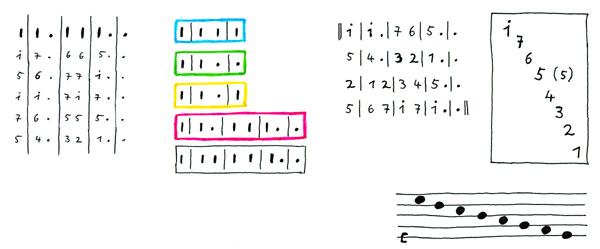
Closeup of blackboard used in Brandt’s classroom video
All rights to the video belong to Gisbert Brandt, Ward-Zentrum Köln e.V., Longericher Straße 370; 50739 Köln; Tel.: 0221-599 59 08; Fax: 0221-957 30 71.
Lesson Notes - A
Singing first
The Ward Method focuses on singing as the foundation of musical instruction. Children learn to express themselves musically in much the same way that they do in the spoken word. The method makes no use of extraneous musical instruments, but relies instead on a child’s own experience with singing and body movement.
The structure of method itself comes from the knowledge that elementary aged children (especially in the first and second grades) do not learn in generalities, but tend to focus, instead, on specific parts of a whole before applying knowledge more broadly. The Ward method makes use of this fact in that it subdivides music into discrete elements which are taught individually before recombining them to make a whole:
1. Voice production
The goal in teaching voice production is to guide children in finding their own melodic and well-tuned instruments: with the help of simple exercises, the child gains a sense of his own singing voice. The vocal compass is developed step by step, all the while paying attention to correct placement of the voice and beauty of sound.
Lesson Notes - B
2. Ear training
The goal of ear training is twofold: it aids the child in the formation of notes and sharpens his ability to imagine the different notes of a scale. The Ward Method makes use of a system known as Solfege, wherein a note is thought of not in terms of an absolute pitch, but in terms of its position relative to other notes in a given scale. The child’s attention is steered toward clean intonation. Ear training, in addition, assists a child in developing his musical memory.
Ward Method lessons begin with building the major scale, starting with the tonic and moving up to the dominant (do re mi fa sol). The lessons continue by starting at high “do” and moving back down to the dominant (do ti la sol) before moving on to the third step of combining the two to form the complete scale.
Through this division of the notes of the pentachord (do re mi fa sol) and tetrachord (do ti la sol), children develop a sense of the tension between tonics and dominants early on. Furthermore, it makes way for an easier understanding of the relationship between plagal and authentic forms of a scale at a later time.
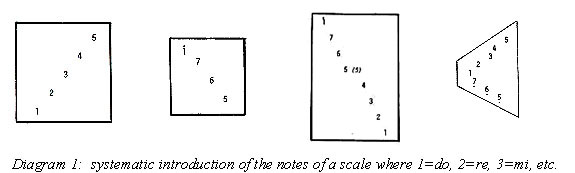
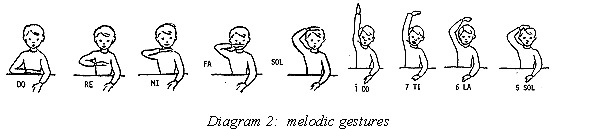
As a help in the development of a musical imagination and memory, the Ward Method introduces specific hand motions, or melodic gestures, whereby each note is attached to a particular position on the body.
Lesson Notes - C
3. Rhythm
The method imparts a sense of rhythm to the children through the use of a prescribed set of dance-like movements. Children stand up at various intervals during class time and mimic movements made by their teacher, whose body is positioned in mirror image to those of the children.This is all done in time to music or song. The idea is that the children learn to feel the music in their whole bodies, from the lift of their feet and the bend in their knees up through the sweeping movement of their arms. Applying movement to what is audible informs a precise understanding of different note values and fosters an intuitive sense of the musical line.
4. Notation
The children learn verbal and written means to aid in melody retention. They learn the simple forms with the same ease that accompanies their learning of written language. In other words, their learning to “read music” corresponds directly to their learning to read letters. Child-friendly and simple forms of notation prepare them for more complex forms of musical notation.
The Ward method assigns a number to each of the syllables of found in the Solfege system. This approach makes sense, because most children can read the numbers one through seven by the age of six. With the addition of dots either above or below these numbers, a range of three octaves can be easily rendered.

Diagram 3: number notation applied to the syllables of Solfege; the caret indicates the position of the half step
Lesson Notes - D
The Ward Method teaches children to read and write down metrical patterns as well. Metrical notation takes a stroke/dot format, with the stroke indicating a sung note, and the dot indicating that the note before appearing before it is to be held that additional length of time.Children can combine metrical patterns arbitrarily. Longer metrical sequences consisting of more than one line are the end result. These, in turn, can serve as a basis for a melody.
Here is an example of a combination of patterns in 2/4:
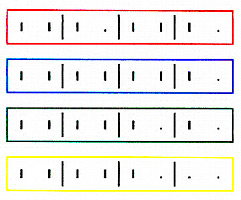
Diagram 4: metrical pattern
These metrical patterns can also be expressed through metrical language. Each individual value unit is assigned a sound syllable: half note: long; quarter note: la; eighth note: li-ra. Children learn hand gestures, or metrical gestures which correspond to these sound syllables. They learn to sing the sound syllables “la” and “long” while counting the same into the palms of their hands.The Ward Method’s number and stroke/dot notation systems are useful in teaching beginners because they are one dimensional. Number notation addresses only one aspect, pitch, and the rhythmic stroke/dot notation, likewise, addresses only duration. This makes it easy for children to concentrate on each of the aspects individually. The two forms of notation (number and stroke/dot) can then be easily combined, resulting in a number notation with an added element of dimensionality:
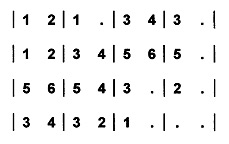
Diagram 5: a four-line melody
5. Improvisation
An important objective of the Ward Method is for each child to develop musical independence. Students should not only be able to reproduce music, but should be able to articulate their own musical ideas. They learn to improvise and generate small compositions through the use of familiar melodic and rhythmic material.
6. Melodies and Songs
The songs and melodies contained in the Ward Method are carefully selected to correspond to the children’s level of proficiency. The above-mentioned elements necessary to the making of music are brought together in a meaningful synthesis.
Conclusion
The Ward Method Lesson
These different elements are introduced in rapid succession within a single Ward lesson. This prevents a loss of interest or fatigue that can come about by drilling one thing too long. This approach also lends a balanced sense of importance to each aspect of music learning, with no one element being prized over another. The focus on specific elements will shift every two or three minutes within a twenty minute lesson. The benefit is that the lesson remains playful, which in turn has a positive effect on a child’s motivation.From lesson to lesson, the difficulty of the material, i.e., the range of melodic and rhythmic tools available for the children’s use, is progressively increased.
The aim of the lessons is for the children to exhibit musical independence. They learn a melody or song under the lively guidance of their teacher, but without the teacher’s having sung the material to them over the course of the lesson. The teacher acts as a facilitator in their ever growing ability to solve musical problems on their own.
Music for everyone
The Ward Method should be taught to students in their first few years of school – not necessarily by specially trained music teachers, but by classroom teachers as well, making music a normative part of every child’s educational experience.Classes in teaching the Ward Method are conducted every summer at The Catholic University of America, and at various Ward Centers throughout the world. These courses are intended for all who wish to teach the method, not just those with a formal musical background. The only prerequisites are the love of music, and most of all, singing.
–Translated by Arlene Oost-Zinner
Historic Texts
These texts are provided for historic study only. Those interested in learning the Ward Method of instruction are encouraged to study at the International Center for Ward Studies at the Catholic University of America, and the current Ward Method editions are available from Catholic University of America Press.


Ward-inspired Resources
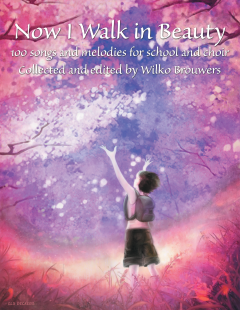
Now I Walk in Beauty - Wilko Brouwers
100 songs, melodies, and musical exercises to be used in music lessons and choir rehearsals based on the Ward Method. A master of the Ward method, Wilko Brouwers developed this wonderful collection of songs and melodies for use in teaching the Ward method to children. Progressing from the simple use of numbers to teach the children the first building blocks of solfege, all the way to a complete five-line staff , 2-part choral piece, Brouwers beautifully incorporates the fundamental elements of the Ward Method in this lovely collection.
With a complete index with information about each melody or song, he also adds an appendix with detailed instruction for the teacher regarding the teaching elements for each lesson including a suggested pitch, intonation, rhythm, gestures and notation.
This book is a great tool for the Ward method teacher, or for use in combination with other methods with up-to-date, fresh repertory.